Monday, May 11, 2015
Sunday, May 3, 2015
Review Countdown to the AP EXAM - Day 1!!!!
Well, this is it. Just one more day until the big day. You all have worked very hard this year and learned loads of stuff. Whatever your scores may be after tomorrow, thank you for investing so much into this class. I hope more than anything that some of the principles we've discussed will serve you well in the rest of life.
A few last minute things...
I am posting this full length exam one more time - have you taken it yet? This will not only give you an idea of what score you may get on the AP but will also give you some practice in answering questions like those you will find on the exam Monday. Barron's Full Length Practice Exam
Check out any of these review videos that I didn't post, especially the ones covering areas you need some additional help in. Psych Review Videos
Some other things to remember:
- Make sure you arrive in plenty of time for the exam. If you are late you will not be allowed in. Also, being a homes-schooled student you may have additional paperwork, etc. to do. BE AT LEAST 1 HOUR EARLY!!!!! As soon as you arrive, inform someone of who you are and why you are present.
- Wear comfortable clothes. It's not a fashion show.
- Bring ONLY blue/black pens, pencils and erasers. Also, a watch that doesn't beep. You won't need anything else for the exam, so just leave it all behind.
- Make sure you guess on the multiple choice questions - there's no penalty for wrong answers.
- Get plenty of sleep tonight, so you are fresh and rested tomorrow.
- Eat a good breakfast in the morning.
- Pray before the test, at this point there is little else you can do, so it's best to give it over to God.
A few last minute things...
I am posting this full length exam one more time - have you taken it yet? This will not only give you an idea of what score you may get on the AP but will also give you some practice in answering questions like those you will find on the exam Monday. Barron's Full Length Practice Exam
Check out any of these review videos that I didn't post, especially the ones covering areas you need some additional help in. Psych Review Videos
Some other things to remember:
- Make sure you arrive in plenty of time for the exam. If you are late you will not be allowed in. Also, being a homes-schooled student you may have additional paperwork, etc. to do. BE AT LEAST 1 HOUR EARLY!!!!! As soon as you arrive, inform someone of who you are and why you are present.
- Wear comfortable clothes. It's not a fashion show.
- Bring ONLY blue/black pens, pencils and erasers. Also, a watch that doesn't beep. You won't need anything else for the exam, so just leave it all behind.
- Make sure you guess on the multiple choice questions - there's no penalty for wrong answers.
- Get plenty of sleep tonight, so you are fresh and rested tomorrow.
- Eat a good breakfast in the morning.
- Pray before the test, at this point there is little else you can do, so it's best to give it over to God.
Saturday, May 2, 2015
Countdown Review to the AP EXAM - Day 2!
Why don't you take one last review exam. This is another one just like the AP exam and will help you practice the format of the exam itself. Barron's Full Length Practice Exam
Also, check out any of the crashcourse videos that you have not watched, just google crashcourse, psychology.
Finally, I recommend you use all of your remaining practice time taking practice quizzes That's the best way to prepare at this point.
Also, check out any of the crashcourse videos that you have not watched, just google crashcourse, psychology.
Finally, I recommend you use all of your remaining practice time taking practice quizzes That's the best way to prepare at this point.
Friday, May 1, 2015
Countdown Review to the AP EXAM - Day 3
As I've said before, I like this list of terms. If you haven't already, print it and highlight all the ones you know and then work on the ones you don't know. 425 Terms You Should Know
Now that your final has been graded, you should have some idea of which areas you are weakest in. Use practice quizzes to help you review and prepare for those subjects. Here are the ones I've been giving you all along, are there any you haven't done yet? PRACTICE QUIZZES
On our last day for topic review, why don't you take a bit of time to review treatment of psychological disorders. Here are flashcards.
A video on depression and ECT:
Now that your final has been graded, you should have some idea of which areas you are weakest in. Use practice quizzes to help you review and prepare for those subjects. Here are the ones I've been giving you all along, are there any you haven't done yet? PRACTICE QUIZZES
On our last day for topic review, why don't you take a bit of time to review treatment of psychological disorders. Here are flashcards.
A video on depression and ECT:
Thursday, April 30, 2015
Wednesday, April 29, 2015
Countdown Review to the AP EXAM - Day 5
Only a couple of days left!!!! Take some time to watch these videos. Other than this, the most helpful thing to be doing at this point is taking practice tests. Practice tests help you in preparing for the actual types of questions you'll get and will help you see your weak areas.
Review your Abnormal Psychology information today - since it was one of the last things we studied, it should be more familiar to you (remember serial positioning effect). For fun, why don't you take this psychopathy test.
And why not do some flashcards and a review quiz.
Crash course videos:
For those for whom watching videos is the best kind of review - here's a bunch of videos on several challenging topics.
Review your Abnormal Psychology information today - since it was one of the last things we studied, it should be more familiar to you (remember serial positioning effect). For fun, why don't you take this psychopathy test.
And why not do some flashcards and a review quiz.
Crash course videos:
For those for whom watching videos is the best kind of review - here's a bunch of videos on several challenging topics.
Tuesday, April 28, 2015
Countdown Review to the AP EXAM - Day 6
Today's topic? A second look at states of consciousness. The first review focused on sleep and sleep cycles. This time, let's focus on alternate states of consciousness - drugs, hypnosis, dreams. Can you summarize the different theories of dreams as well as theories of hypnosis?
Start with some flashcards and then take a quiz.
This is an interesting article on hypnosis. What do you think?
Take some time to review the different types of drugs, and the effects of each. Use the chart I gave you as well as the 'mouse drug party'.
Start with some flashcards and then take a quiz.
This is an interesting article on hypnosis. What do you think?
Take some time to review the different types of drugs, and the effects of each. Use the chart I gave you as well as the 'mouse drug party'.

Monday, April 27, 2015
Review Countdown to the AP EXAM - Day 7
And emotion....
Why don't you start with some flashcards.
Look at this useful chart of the theories of emotions. And the answers.
Some videos unrelated to emotion but important nonetheless...
Sunday, April 26, 2015
Review Countdown to the AP EXAM - Day 8
Only a few topics left. Today let's talk about motivation and work.
Here is a quiz to see how well you know motivation and emotion, and to help you in your test taking abilities, one of the most important things to focus on at this stage. Spend today reviewing motivation and work, then tomorrow we'll focus on emotion.
Didn't do as well as you hoped? Why don't you practice these flashcards.
Let's try something a little different. How many of the blanks in this CHART on hunger and eating behavior can you fill in? Check them with the answers.
Or how about this CHART on motivation and work. And the the answers.
Here is a quiz to see how well you know motivation and emotion, and to help you in your test taking abilities, one of the most important things to focus on at this stage. Spend today reviewing motivation and work, then tomorrow we'll focus on emotion.
Didn't do as well as you hoped? Why don't you practice these flashcards.
Let's try something a little different. How many of the blanks in this CHART on hunger and eating behavior can you fill in? Check them with the answers.
Or how about this CHART on motivation and work. And the the answers.
Saturday, April 25, 2015
Review Countdown for the AP EXAM - DAY 9
Pavlov's dogs and US, UR, CS, CR: what topic is it? That's right, classical conditioning, under the broader category of learning. You absolutely must be able to explain how conditioning happens and be able to give examples of it, not to mention be able to identify the unconditioned stimulus, unconditioned response, conditioned stimulus, and conditioned response in a scenario.
This diagram should be very familiar to you:

Check out this video and identify the US, UR, CS, CR.
Are you able to define these terms in the context of classical conditioning? discrimination, generalization, extinction, spontaneous recovery, acquisition, and delayed, trace, simultaneous, and backward conditioning.
Finally, do you remember John Watson and his experiment with 'Little Albert'?
Here are some more unrelated but helpful videos on neurotransmitters:
Since the exam is coming closer and closer, it seems appropriate to talk again about stress and health. Fun fact: did you know that April is National Stress Awareness Month? Yeah, I didn't either. And I realize that it is completely meaningless information. But it does mean some interesting information is being posted related to stress.
An article on the effects of stress on the body and how to manage stress. Do any of these things help you?
Spark Notes are my favorite.
This diagram should be very familiar to you:
Check out this video and identify the US, UR, CS, CR.
Are you able to define these terms in the context of classical conditioning? discrimination, generalization, extinction, spontaneous recovery, acquisition, and delayed, trace, simultaneous, and backward conditioning.
Finally, do you remember John Watson and his experiment with 'Little Albert'?
Here are some more unrelated but helpful videos on neurotransmitters:
Since the exam is coming closer and closer, it seems appropriate to talk again about stress and health. Fun fact: did you know that April is National Stress Awareness Month? Yeah, I didn't either. And I realize that it is completely meaningless information. But it does mean some interesting information is being posted related to stress.
An article on the effects of stress on the body and how to manage stress. Do any of these things help you?
Spark Notes are my favorite.
Friday, April 24, 2015
Review Countdown to the AP EXAM - Day 10
How much do you remember about Heredity and Environment? Take some time to review this topic today. Though not as extensively covered on the exam as some other topics, it is still important to be familiar wiht these terms: the nature-nurture debate, genes and genetics, chromosomal abnormalities, twin and adoption studies, temperament, and theories of gender development.
Quizlet Terms for heredity and environment.
General Review Resources:
If you haven't created or found a good summary review guides, here is one. Doesn't have everything, but has lots of information.
Here is a general review website. I posted it before too, but here it is again, in case you missed it.
Quizlet Terms for heredity and environment.
General Review Resources:
If you haven't created or found a good summary review guides, here is one. Doesn't have everything, but has lots of information.
Here is a general review website. I posted it before too, but here it is again, in case you missed it.
Thursday, April 23, 2015
Review Countdown to the AP EXAM - Day 11
Today's topic is social psychology again.
See how much you know with this Social Psychology Quiz.
Do you need a bit more study? Here is Spark Notes.
And here is are a few other resources.
Here is an article about how walking helps your mind - ties into memory, stress and health, and the way that you are studying for this exam! Check it out.
There are lots of crashcourse videos on social psychology. Here are three - check them out. I didn't get a chance to watch all three of these completely, so let me know what you think of them.
See how much you know with this Social Psychology Quiz.
Do you need a bit more study? Here is Spark Notes.
And here is are a few other resources.
Here is an article about how walking helps your mind - ties into memory, stress and health, and the way that you are studying for this exam! Check it out.
There are lots of crashcourse videos on social psychology. Here are three - check them out. I didn't get a chance to watch all three of these completely, so let me know what you think of them.
Wednesday, April 22, 2015
Review Countdown to the AP EXAM - Day 12
Spend some time at Quia, where you'll find lots of games, quizzes and review activities.
Interesting article about personality and if/how it changes during the lifespan. It focuses primarily on the Big 5 Personalty traits - do you remember what they are?
Spark Notes Personality Review
Remember Freud's Theory of Personality?

You may have already watched this...
Interesting article about personality and if/how it changes during the lifespan. It focuses primarily on the Big 5 Personalty traits - do you remember what they are?
Spark Notes Personality Review
Remember Freud's Theory of Personality?
You may have already watched this...
Tuesday, April 21, 2015
Review Countdown to the AP EXAM - Day 13
So a little more on sensation and perception:
DISSECT AN EYE
Review Auditory Systems Tasks
A Summary of Vision
See here for an article about the value of Sigmund Freud's work these days. (Unrelated to sensation and perception, but interesting nonetheless.)
DISSECT AN EYE
Review Auditory Systems Tasks
A Summary of Vision
See here for an article about the value of Sigmund Freud's work these days. (Unrelated to sensation and perception, but interesting nonetheless.)
Monday, April 20, 2015
Review Countdown to the AP EXAM - Day 14
Today and tomorrow we'll review sensation and perception. Since they are intertwined there will be a bit of both on each day.
What does this article tell us about sensation and perception?
SPARK NOTES REVIEW
A nifty perception video
What does this article tell us about sensation and perception?
SPARK NOTES REVIEW
A nifty perception video
Sunday, April 19, 2015
Review Countdown to the AP EXAM - Day 15
Let's review Memory today. Make sure the following terms have been encoded into your memory: information processing model, sensory memory (iconic, ecoic, selective attention), short term memory or working memory, chunking, mnemonic devices, longterm memory (implicit/explicit), hippocampus, episodic memory, semantic memory, procedural memory, eidetic memory, encoding, storage, retrieval...hopefully you get the idea. Study everything having to do with memory.

Try these Memory Games
And Memory Flashcards
And A Memory Quiz
This doesn't have to do with memory, but here are some important charts and diagrams you want to become quite familiar with - before May 4th. Would you be able to explain each of these charts to someone who's never seen them before? If not, review!


Try these Memory Games
And Memory Flashcards
And A Memory Quiz
This doesn't have to do with memory, but here are some important charts and diagrams you want to become quite familiar with - before May 4th. Would you be able to explain each of these charts to someone who's never seen them before? If not, review!
 |
| The famous "Normal Curve" or "Bell Shaped Curve" |
 |
| Neuroscience or The Biology of the Brain |
 |
| Classical Conditioning |
 |
| Schizophrenia and Genetic Links |
Saturday, April 18, 2015
Review Countdown to the AP EXAM - Day 16
This is a slightly strange quiz, but a good way to see these terms in a different context. What do you think? How did you do?
Why don't we take a quick look at the History of Psychology today?
Here is a good place to start your review.

Some flashcards.
Make sure you know these people and terms: Wilhelm Wundt, Edward Titchener, functionalism, structuralism, psychoanalysis, John Watson, William James, and Mary Calkins.
Why don't we take a quick look at the History of Psychology today?
Here is a good place to start your review.
Some flashcards.
Make sure you know these people and terms: Wilhelm Wundt, Edward Titchener, functionalism, structuralism, psychoanalysis, John Watson, William James, and Mary Calkins.
Friday, April 17, 2015
Review Countdown to the AP EXAM - Day 17
Today's topic: thinking and language. This falls under the broader topic of cognition, along with memory.
Here is an interesting article on how our thinking can impact our bodies. Remember the brain can change the mind, and the mind can change the brain/body.
Of course, some flashcards.
And 56 multiple choice review questions.
A quick example of the availability heuristic (also review problem solving concepts, the representative heuristic and algorithms):
Language is another big part of cognition, so make sure you are familiar with things like phonemes, morphemes, semantics, syntax, word salad, language acquisition and the critical period hypothesis. Which parts of the brain are specially involved in language?
If you are particularly interested in children's acquisition of language, check out this video. It is a bit long and wordy, so don't waste the time on it if you're aren't interested.
A general crashcourse video on cognition...
What do you think about the information regarding animals learning language? Do you think animals are just as competent as humans when it comes to language? Is language something that can be used as an example of what separates humans from animals?
Finally, do you remember our discussion of Genie? What do we mean when we talk about feral children? How are their language skills and cognition disrupted?
Here is an interesting article on how our thinking can impact our bodies. Remember the brain can change the mind, and the mind can change the brain/body.
Of course, some flashcards.
And 56 multiple choice review questions.
A quick example of the availability heuristic (also review problem solving concepts, the representative heuristic and algorithms):
Language is another big part of cognition, so make sure you are familiar with things like phonemes, morphemes, semantics, syntax, word salad, language acquisition and the critical period hypothesis. Which parts of the brain are specially involved in language?
If you are particularly interested in children's acquisition of language, check out this video. It is a bit long and wordy, so don't waste the time on it if you're aren't interested.
A general crashcourse video on cognition...
What do you think about the information regarding animals learning language? Do you think animals are just as competent as humans when it comes to language? Is language something that can be used as an example of what separates humans from animals?
Finally, do you remember our discussion of Genie? What do we mean when we talk about feral children? How are their language skills and cognition disrupted?
Thursday, April 16, 2015
Review Countdown to the AP EXAM - Day 18
The topic for today? Another look at research and statistics. This is another hugely important topic to understand thoroughly for the AP exam.
Check out the Top Ten Psychology Research Studies
And don't forget to use Spark Notes for reviewing every topic: Research Methods Quick Review
Here's a specific research study, all about the Cocktail Party Effect (a concept that is still confusing to some)
A summary of some information you should know.
Check out this VIDEO on reliability and validity.
Are you familiar with this diagram?

There's only one crashcourse video on research and statistics, so I'm posting the same one again. If you didn't watch it (or even if you did), have a look...
Is that enough for today? I think so. Keep studying!
I know it's not on topic, but I came across this:
'You didn't want to come. The average man don't like trouble and danger. You don't like trouble and danger. But if only half a man - like Buck Harkness, there - shouts 'lynch him, lynch him!' you're afraid to back down - afraid you'll be found out to be what you are - cowards - and so you raise a yell, and hang yourselves on to that half-a-man's coat tail, and come raging up here, swearing what big things you're going to do. The pitifullest thing out is a mob; that's what an army is - a mob; they don't fight with courage, that's borrowed from their mass, and from their offices. But a mob without a man at the head of it is beneath pitifulness." Huckleberry Finn
Reminded me again of social psychology - any thoughts?
Check out the Top Ten Psychology Research Studies
And don't forget to use Spark Notes for reviewing every topic: Research Methods Quick Review
Here's a specific research study, all about the Cocktail Party Effect (a concept that is still confusing to some)
A summary of some information you should know.
Check out this VIDEO on reliability and validity.
Are you familiar with this diagram?
There's only one crashcourse video on research and statistics, so I'm posting the same one again. If you didn't watch it (or even if you did), have a look...
Is that enough for today? I think so. Keep studying!
I know it's not on topic, but I came across this:
'You didn't want to come. The average man don't like trouble and danger. You don't like trouble and danger. But if only half a man - like Buck Harkness, there - shouts 'lynch him, lynch him!' you're afraid to back down - afraid you'll be found out to be what you are - cowards - and so you raise a yell, and hang yourselves on to that half-a-man's coat tail, and come raging up here, swearing what big things you're going to do. The pitifullest thing out is a mob; that's what an army is - a mob; they don't fight with courage, that's borrowed from their mass, and from their offices. But a mob without a man at the head of it is beneath pitifulness." Huckleberry Finn
Reminded me again of social psychology - any thoughts?
Wednesday, April 15, 2015
Review Countdown to the AP EXAM - Day 19
Let's get creative in our memorizing. Here are some nifty tools to help you better memorize some of the more difficult material - especially psychology and the brain.
Click here to look at sample psychology mnemonics and then use the tool to make your own!
Today we will be spending some more time on the brain and neuroscience. Remember that this will be one of the biggest sections on the exam!
Last time we looked at the crash course video on the structures of the brain. But now we need to look at neurons and neurotransmitters. I recommend that you watch this video a few times and review your notes to make sure you understand and remember 1) the process of neuron firing, 2) what happens at the synaptic gap, 3) the difference between hormones and neurotransmitters, 4) some of the most important hormones and neurotransmitters.

Click here to look at sample psychology mnemonics and then use the tool to make your own!
Today we will be spending some more time on the brain and neuroscience. Remember that this will be one of the biggest sections on the exam!
Last time we looked at the crash course video on the structures of the brain. But now we need to look at neurons and neurotransmitters. I recommend that you watch this video a few times and review your notes to make sure you understand and remember 1) the process of neuron firing, 2) what happens at the synaptic gap, 3) the difference between hormones and neurotransmitters, 4) some of the most important hormones and neurotransmitters.
Tuesday, April 14, 2015
Review Countdown to the AP EXAM - Day 20
A few more things on Social Psychology:
First of all, look at this fascinating and sobering look at Deindividuation
Here's a test of the Mere Exposure Effect
Can't talk about social psychology without mentioning Phil Zimbardo and his famous Standford Prison Experiment, a turning point in the study of social psychology.
There's lots more in social psychology: conformity, bystander intervention, social norms, prejudice, stereotyping, aggression, love and attraction, group polarization, ingroup bias...
And if you don't feel inclined to study, but want to waste time in a social-psychology sort of way, play The Prisoner's Dilemma
Here's another general and very useful resource for studying: AP Psych Practice Quizzes
Have fun!
First of all, look at this fascinating and sobering look at Deindividuation
Here's a test of the Mere Exposure Effect
Can't talk about social psychology without mentioning Phil Zimbardo and his famous Standford Prison Experiment, a turning point in the study of social psychology.
There's lots more in social psychology: conformity, bystander intervention, social norms, prejudice, stereotyping, aggression, love and attraction, group polarization, ingroup bias...
And if you don't feel inclined to study, but want to waste time in a social-psychology sort of way, play The Prisoner's Dilemma
Here's another general and very useful resource for studying: AP Psych Practice Quizzes
Have fun!
Monday, April 13, 2015
Review Countdown to the AP EXAM - Day 21
Since we have class today, and you'll already be spending a significant time on psychology, why don't you just review States of Consciousness. As you can see from the outline below, States of Consciousness is only 2-4% of the material on the exam, so not as important as areas like Biological Bases of Behavior (8-10%). Use the outline to guide your study.
Here is an interesting article on taking naps and how long naps should be to have optimal benefit. Take the time to review the circadian rhythm, sleep cycles, sleep disorders.
As always, SparkNotes is a great tool for reviewing this topic.
Don't forget the ever helpful Mouse Drug Party for a summary of the effects of different drugs, plus the drug substance chart I posted under Week 26 on coursesites.
As always, SparkNotes is a great tool for reviewing this topic.
Don't forget the ever helpful Mouse Drug Party for a summary of the effects of different drugs, plus the drug substance chart I posted under Week 26 on coursesites.
Here is the official outline of all the subject areas for the AP exam. Spend extra time in the areas with higher percentages, as well as the items you are less familiar with.
I. History and Approaches (2–4%)
- Logic, Philosophy, and History of Science
- Approaches:
- Biological
- Behavioral
- Cognitive
- Humanistic
- Psychodynamic
- Sociocultural
- Evolutionary/Sociobiological
II. Research Methods (6–8%)
- Experimental, Correlational, and Clinical Research:
- Correlational (e.g., observational, survey, clinical)
- Experimental
- Statistics:
- Descriptive
- Inferential
- Ethics in Research
III. Biological Bases of Behavior (8–10%)
- Physiological Techniques (e.g., imaging, surgical)
- Neuroanatomy
- Functional Organization of Nervous System
- Neural Transmission
- Endocrine System
- Genetics
IV. Sensation and Perception (7–9%)
- Thresholds
- Sensory Mechanisms
- Sensory Adaptation
- Attention
- Perceptual Processes
V. States of Consciousness (2–4%)
- Sleep and Dreaming
- Hypnosis
- Psychoactive Drug Effects
VI. Learning (7–9%)
- Classical Conditioning
- Operant Conditioning
- Cognitive Processes in Learning
- Biological Factors
- Social Learning
VII. Cognition (8–10%)
- Memory
- Language
- Thinking
- Problem Solving and Creativity
VIII. Motivation and Emotion (7–9%)
- Biological Bases
- Theories of Motivation
- Hunger, Thirst, Sex, and Pain
- Social Motives
- Theories of Emotion
- Stress
IX. Developmental Psychology (7–9%)
- Life-Span Approach
- Research Methods (e.g., longitudinal, cross-sectional)
- Heredity-Environment Issues
- Developmental Theories
- Dimensions of Development:
- Physical
- Cognitive
- Social
- Moral
- Sex Roles, Sex Differences
X. Personality (6–8%)
- Personality Theories and Approaches
- Assessment Techniques
- Self-concept, Self-esteem
- Growth and Adjustment
XI. Testing and Individual Differences (5–7%)
- Standardization and Norms
- Reliability and Validity
- Types of Tests
- Ethics and Standards in Testing
- Intelligence
- Heredity/Environment and Intelligence
- Human Diversity
XII. Abnormal Psychology (7–9%)
- Definitions of Abnormality
- Theories of Psychopathology
- Diagnosis of Psychopathology
- Anxiety Disorders
- Somatoform Disorders
- Mood Disorders
- Schizophrenic Disorders
- Organic Disorders
- Personality Disorders
- Dissociative Disorders
XIII. Treatment of Psychological Disorders (5–7%)
- Treatment Approaches:
- Insight Therapies: Psychodynamic/Humanistic Approaches
- Behavioral Approaches
- Cognitive Approaches
- Biological Approaches (psychopharmacology/psychosurgery)
- Modes of Therapy (e.g., individual, group)
- Community and Preventive Approaches
XIV. Social Psychology (7–9%)
- Group Dynamics
- Attribution Processes
- Interpersonal Perception
- Conformity, Compliance, Obedience
- Attitudes and Attitude Change
- Organizational Behavior
- Aggression/Antisocial Behavior
Today there are two crashcourse videos!
Sunday, April 12, 2015
Review Countdown to the AP EXAM - Day 22
Review the topic for today...Intelligence. What do you think about "g"? Are there multiple intelligences or just one?
Remember Howard Gardner? Go right to the source: here's where he speaks about his theories of intelligence.
Remember Howard Gardner? Go right to the source: here's where he speaks about his theories of intelligence.
And another useful website for intelligence review: Intelligence stuff
Here are some flash cards, I know you love them! While we're at it, how about looking at the spark notes?
Here are some flash cards, I know you love them! While we're at it, how about looking at the spark notes?
Saturday, April 11, 2015
Review Countdown to the AP EXAM - Day 23
The topic for today is stress and health. When studying stress, you will find yourself encountering many other terms and topics that have popped up in other chapters of the psych textbook. Make sure you use this as a time to review any and all relevant terms you discover.
Here are the quizlet flashcards and a summary of key terms.
Are you starting to stress out about the AP exam? Learn some strategies for healthy ways of handling stress by reviewing this site: Measuring and Dealing with Stress
Have a stress-free and humor-filled weekend!
A video on stress and emotions:
Here are the quizlet flashcards and a summary of key terms.
Are you starting to stress out about the AP exam? Learn some strategies for healthy ways of handling stress by reviewing this site: Measuring and Dealing with Stress
Have a stress-free and humor-filled weekend!
A video on stress and emotions:
Friday, April 10, 2015
Review Countdown to the AP EXAM - Day 24
Let's do some social psychology review today. Can you name all of the most famous social psychology research studies and name the theorist or psychologist who was responsible for each, as well as the purpose and outcome of each study? If not, look them up and review!
There are so many ways to break social norms. What else does this remind you of related to social psychology?
And of course some social psychology flash cards.
Just for fun...what psych topics come to mind when you watch this video?
Found this great review site at Learnerator - go check it out and use these quizzes to test your knowledge in all areas.
There are so many ways to break social norms. What else does this remind you of related to social psychology?
And of course some social psychology flash cards.
Just for fun...what psych topics come to mind when you watch this video?
Found this great review site at Learnerator - go check it out and use these quizzes to test your knowledge in all areas.
Thursday, April 9, 2015
Review Countdown to the AP EXAM - Day 25
Let's start in on Neuroscience and the Brain today. This is one of the biggest topics on the AP Exam, so make sure you spend plenty of time on this! Take a look at some images of the BRAIN . Don't go crazy with this site, just look through it and see what parts of the brain and other terms you recognize.
And some helpful FLASHCARDS.
Make sure you know the parts of the two diagrams below. The four lobes, the limbic system and the anatomy of a neuron are all important things for you to familiarize yourself with.


We will look at neurotransmitters and the chemicals of your brain on another day.
And some helpful FLASHCARDS.
Make sure you know the parts of the two diagrams below. The four lobes, the limbic system and the anatomy of a neuron are all important things for you to familiarize yourself with.
We will look at neurotransmitters and the chemicals of your brain on another day.
Wednesday, April 8, 2015
Review Countdown to the AP EXAM - Day 26
Today's topic is Personality.
THIS is an EXTREMELY useful review website, specifically geared toward preparing you for psych tests. Please take some time to check out the site and use it for review. It will help you to review Personality, but also Biological psych, Learning, Psych Disorders, and Research Methods in a different format. Seriously, I cannot overemphasize how helpful this resource it to give you an overall picture of different theories and concepts. Check it out.
THIS is an EXTREMELY useful review website, specifically geared toward preparing you for psych tests. Please take some time to check out the site and use it for review. It will help you to review Personality, but also Biological psych, Learning, Psych Disorders, and Research Methods in a different format. Seriously, I cannot overemphasize how helpful this resource it to give you an overall picture of different theories and concepts. Check it out.
HERE are the quizlet flashcards having to do with personality.
Also, interesting tidbit on personality and facebook users....http://www.cnn.com/2009/TECH/08/20/annoying.facebook.updaters/index.html
(Not of any true value in studying for the exam.)
Crashcourse on personality...
How much do you know? Take a quiz!
Crashcourse on personality...
How much do you know? Take a quiz!
Tuesday, April 7, 2015
Review Countdown to the AP EXAM - Day 27
Today's topic? Learning. On another day of review we will focus more on classical conditioning, but spend time today on terms and people related to operant conditioning: B.F. Skinner and his rat box, Edward Thorndike and his cats, positive punishment, negative punishment, positive reinforcement, negative reinforcement, learned helplessness, shaping, chaining, primary reinforcement, secondary reinforcements, acquisition, extinction, discrimination, generalization, spontaneous recovery, schedules of reinforcment...and be sure you can list examples of each. All of those terms and more can be reviewed HERE and HERE.
Also keep in mind...
What type of reinforcements and/or punishments does Dwight use?
And of course, the crashcourse video...includes information on Pavlov and classical conditioning, but we will look at those things more in depth on another day.
Have time for a little more? Why not take this quiz and see how well you were paying attention.
 |
| The Overjustification Effect |
And of course, the crashcourse video...includes information on Pavlov and classical conditioning, but we will look at those things more in depth on another day.
Have time for a little more? Why not take this quiz and see how well you were paying attention.
Monday, April 6, 2015
Schizophrenia
Sometimes I must stoop to using Oprah's videos. Here's one where she interviews a young girl with Schizophrenia. Can you identify any specific symptoms of Schizophrenia?
http://www.oprah.com/oprahshow/Oprah-Meets-a-Child-with-Schizophrenia-Video
http://www.oprah.com/oprahshow/Oprah-Meets-a-Child-with-Schizophrenia-Video
Review Countdown to the AP EXAM - Day 28
Let's continue our review of development through the lifespan today, focusing on adolescent and adult development. Names to review - Erikson, Freud, Kohlberg.
Here is a great chart to compare all of the different developmental theorists and what happens at each stage of life. Print and MEMORIZE this chart. All of the information on it should be familiar to you.
Read this to refresh your mind about Adult Development.
As a general review resource, if you're looking for simpler and less technical definitions of psychology terms, here's a great resource: Psychology Glossary
Try searching for the words and concepts that you've had the most difficult time understanding. You can start your own collection of flashcards too!
And of course, the two crashcourse videos related to human development. Get out your class notes and review whatever is not familiar to you!!
Here is a great chart to compare all of the different developmental theorists and what happens at each stage of life. Print and MEMORIZE this chart. All of the information on it should be familiar to you.
Read this to refresh your mind about Adult Development.
As a general review resource, if you're looking for simpler and less technical definitions of psychology terms, here's a great resource: Psychology Glossary
Try searching for the words and concepts that you've had the most difficult time understanding. You can start your own collection of flashcards too!
And of course, the two crashcourse videos related to human development. Get out your class notes and review whatever is not familiar to you!!
Quick Review
Check out this article on a study done with identical twins. What kind of study is it? What does it tell us about nature-nurture and the interplay between genetics and environment?
Sunday, April 5, 2015
Review Countdown to the AP EXAM - Day 29
Happy Easter everyone!!
On our second day of review, let's take a look at child development. Some names to remember: Piaget and his stages of development, Harlow and his monkeys, Mary Ainsworth and her attachment theories...
What ideas about attachment did Harlow seek to prove with his experiments with monkeys?
There is no point to this video, other than to enjoy the sheer delight of childhood.
At what age does separation anxiety begin? How do you see it demonstrated in this video?
Why don't you take this QUIZ on child development and see how much you know (and how much you need to review!).
On our second day of review, let's take a look at child development. Some names to remember: Piaget and his stages of development, Harlow and his monkeys, Mary Ainsworth and her attachment theories...
What ideas about attachment did Harlow seek to prove with his experiments with monkeys?
There is no point to this video, other than to enjoy the sheer delight of childhood.
At what age does separation anxiety begin? How do you see it demonstrated in this video?
Why don't you take this QUIZ on child development and see how much you know (and how much you need to review!).
Saturday, April 4, 2015
Review Countdown to the AP EXAM - Day 30
One month from today is the AP Psychology Exam!!
Over the next thirty days I will be posting resources each day to help you review the different topics we've studied over the course of the year. I encourage you to not only view the things that I post but also take the opportunity to use your notes, the powerpoints and the textbook to study the same topic.
Let's start with a bit of research methods. Correlation does not equal causation! If this cartoon does not make sense to you, you probably need to go back and review the concepts of correlation vs. causation. While you're at it, why don't you review the differences between case studies, correlative studies, and experimental studies.
Over the next thirty days I will be posting resources each day to help you review the different topics we've studied over the course of the year. I encourage you to not only view the things that I post but also take the opportunity to use your notes, the powerpoints and the textbook to study the same topic.
Let's start with a bit of research methods. Correlation does not equal causation! If this cartoon does not make sense to you, you probably need to go back and review the concepts of correlation vs. causation. While you're at it, why don't you review the differences between case studies, correlative studies, and experimental studies.
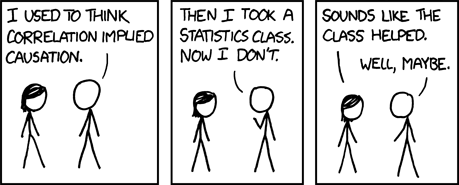 |
| Causation and Correlation |
Check out this helpful website with a summary of all the most important terms in research and statistics: Research Methods Rapid Review
We are going to use a lot of crashcourse videos when doing review because they are excellent at summarizing lots of information quickly. I recommend that you pull out your class notes while watching the video and mark things you need to study more. If anything in the video doesn't sound familiar to you, go back and review!!
We are going to use a lot of crashcourse videos when doing review because they are excellent at summarizing lots of information quickly. I recommend that you pull out your class notes while watching the video and mark things you need to study more. If anything in the video doesn't sound familiar to you, go back and review!!
Monday, March 30, 2015
Monday, March 23, 2015
Monday, March 16, 2015

Tuesday, March 10, 2015
Monday, March 9, 2015
Beauty is in the Eye of the Beholder
An interesting video that surfaced on facebook today. Similar to the Dove video we watched the week we talked about Motivation. Reminded me of issues connected to Bulimia and Anorexia, perception, and social motivation. Check it out: http://realbeautysketches.dove.us/
Thoughts?
Thoughts?
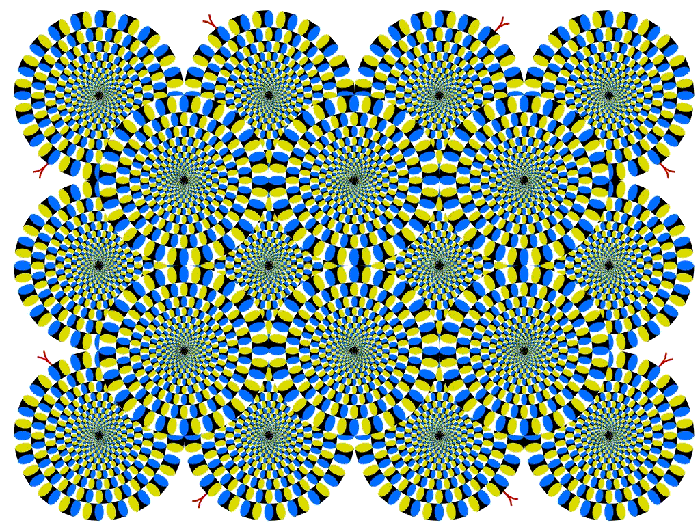
Perception - Illusions
Check out The Illusion Sciences Blog to see various illusions and an explanation of what's happening with our visual perception in each case.
Monday, March 2, 2015
Monday, February 16, 2015

Take the Myers-Briggs
One of the most comprehensive, accurate and informative versions of the Myers-Briggs test that you can take online. Try to take this in preparation for class next week.
http://www.16personalities.com/
http://www.16personalities.com/
Monday, February 9, 2015
Monday, February 2, 2015
Monday, January 26, 2015
Mapping the Nation's Well-Being
This is an interactive map of the country, indicating scores of happiness, depression, physical well-being, and so on. Click on the link below. In what states do the happiest people live?
Mapping Overall Well-Being in the USA

Mapping Overall Well-Being in the USA
Wednesday, January 14, 2015
Monday, January 12, 2015
Monday, January 5, 2015
Subscribe to:
Posts (Atom)